
6 Simple Steps for Your Best Birth
There is a lot of medical research that tells you and your care provider what kind of care will most likely keep your baby’s birth safe and healthy.
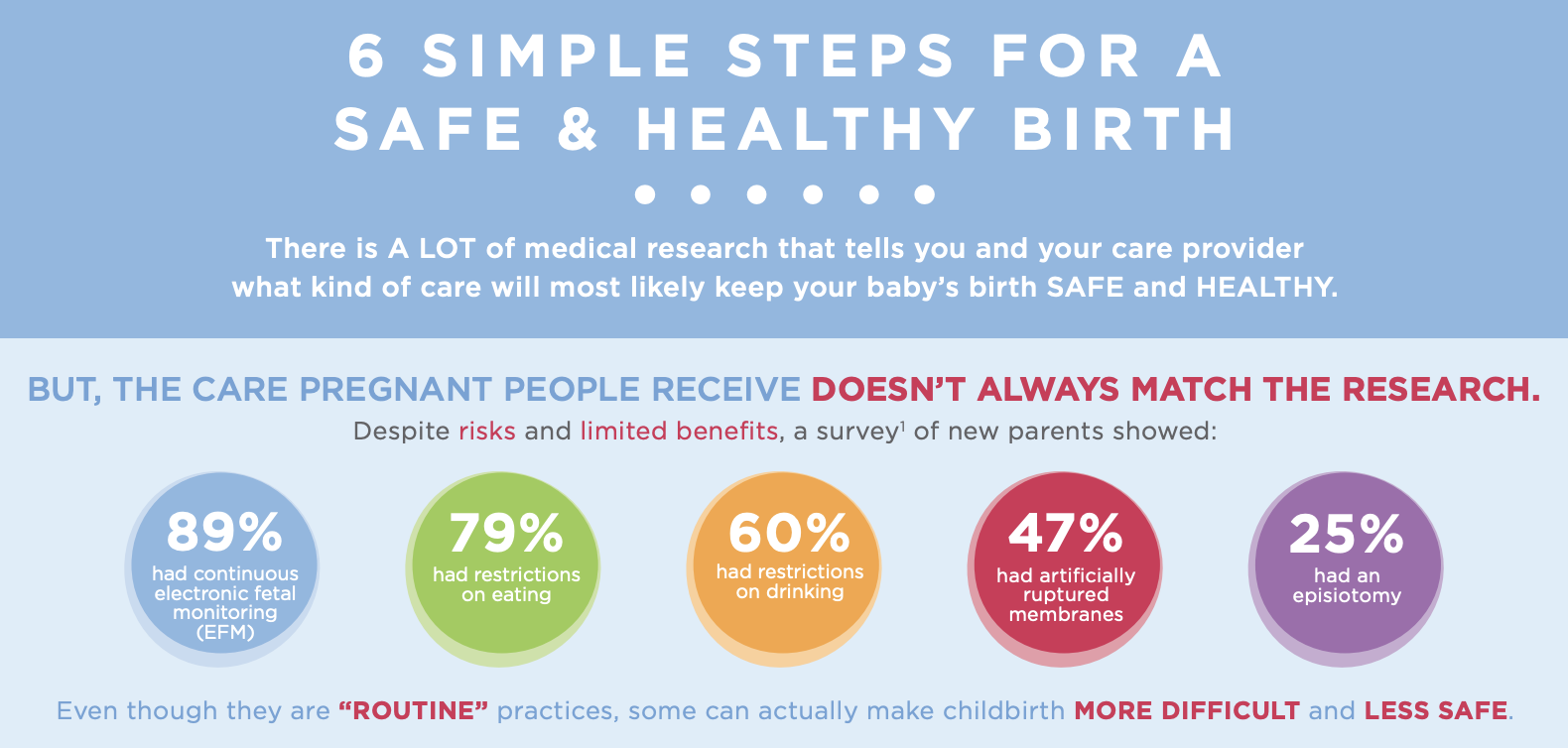
But, the care pregnant people receive doesn’t always match the research. Despite risks and limited benefits, a survey of new parents showed:
- 89% had continuous electronic fetal monitoring
- 79% had restrictions on eating
- 60% had restrictions on drinking
- 47% had artificially ruptured membranes
- 25% had an episiotomy
Even though they are “routine” practices, some can actually make childbirth more difficult and less safe.
Lamaze has summed up years of research into 6 Healthy Birth Practices, proven to promote the safest, healthiest birth possible for parents and babies.
Step #1: Let labor begin on its own.
Normal pregnancy lasts 38-42 weeks!
Natural start of labor usually means your body and your baby are ready for birth
Induction could make contractions harder and stress the baby
Step #2: Walk, move around and change positions throughout labor.
Help your uterus work more e ciently
Use upright positions and gravity to help pull baby down
Actively responding to labor may help you feel more confident, less afraid
Natural start of labor usually means your body and your baby are ready for birth
Induction could make contractions harder and stress the baby
Step #3: Bring a loved one, friend or doula for continuous support.
Praise, reassurance and encouragement decrease stress
Physical support can help decrease pain
Informational support can increase confidence
Use upright positions and gravity to help pull baby down
Step #4: Avoid interventions that are not medically necessary.
Many of these disrupt the birthing process, making it more difficult
Choose a birth setting with a low rate of interventions
Ask if your care provider routinely uses any interventions
During labor, ask if there is another alternative
Step #5: Avoid giving birth on your back and follow your body’s urge to push.
Use gravity to your advantage to shorten the pushing stage
Push when your body tells you
Use upright or side-lying positions
Adjust the hospital bed to support your position.
Step #6: Keep your baby with you – it’s best for you, your baby and breastfeeding
Skin-to-skin during the first hour helps baby transition
Weighing and other routine procedures can wait
Ask which procedures can be done while holding baby
Rooming with baby doesn’t prevent you from sleeping